
Malaysia LNG Export Data – HS Code 2711 Guide
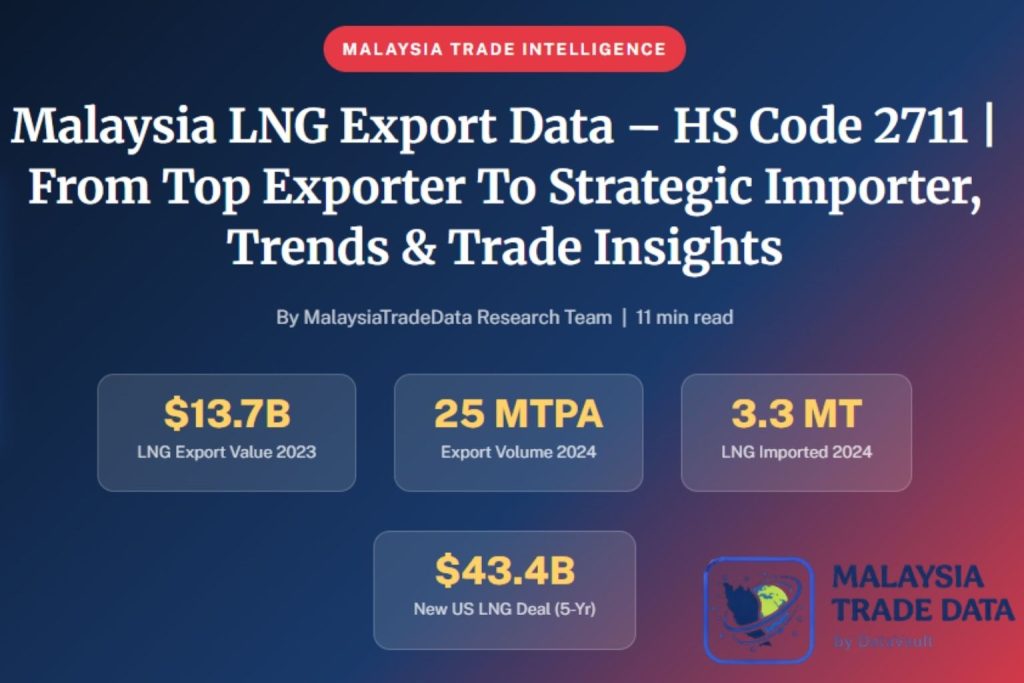
Malaysia LNG Export Data – HS Code 2711 Guide ⚡ Malaysia’s LNG Story Flips: World’s Top Exporter Now Signs $43.4 Billion Deal to Import US Gas as Domestic Demand Surges Malaysia Trade Intelligence Malaysia LNG Export Data – HS Code 2711 | From Top Exporter to Strategic Importer, Trends & Trade Insights By MalaysiaTradeData Research Team | 11 min read $13.7B LNG Export Value 2023 25 MTPA Export Volume 2024 3.3 MT LNG Imported 2024 $43.4B New US LNG Deal (5-Yr) Home › Blog › Malaysia LNG Export Data – HS Code 2711 Malaysia has long been one of the world’s top LNG (liquefied natural gas) exporters, shipping roughly $13.7 billion worth of LNG in 2023 alone. However, a genuinely surprising shift is now underway: Malaysia has quietly become a growing LNG importer too, even as it remains a major exporter. This guide covers Malaysia’s LNG export trend, top buyers, and the strategic pivot reshaping the country’s energy trade. Malaysia LNG Export Market Overview Malaysia’s LNG export industry is anchored by one of the world’s largest LNG production and export terminals, the Bintulu Complex in Sarawak, operated by national energy company Petronas. For decades, this facility has supplied long-term customers across Asia under sales and purchase agreements dating back to the 1970s and 1980s — including major Japanese utilities and Chinese state energy buyers. In 2023, Malaysia exported approximately 28 million tonnes of LNG, generating export revenue of roughly RM59.6 billion (about $13.7 billion). Notably, however, this was a decline from the prior year’s value of roughly RM68 billion (about $15.6 billion) — a drop of around 12%. As a result, this decline set the stage for an even bigger shift that would follow. ⚡ Malaysia LNG (HS 2711) Export Key Statistics Metric Value LNG Export Value (2022) ~$15.6 Billion (RM68.0B) LNG Export Value (2023) ~$13.7 Billion (RM59.6B) Export Volume — Pre-2020 Peak ~32 Million Tonnes/Year Export Volume (2024) ~25 Million Tonnes/Year LNG Imported (2021) 2.1 Million Tonnes LNG Imported (2024) 3.3 Million Tonnes Source: MalaysiaTradeData.com Research Malaysia’s Shrinking LNG Export Volume Even as export value stayed substantial through 2023, Malaysia’s underlying LNG export volume has been quietly declining for years. Export volumes peaked at around 32 million tonnes per year before 2020, then fell to approximately 25 million tonnes per year by 2024 — a decline of roughly 22%. In fact, in the first half of 2025 alone, Malaysia’s main LNG complex exported 11.77 million tonnes, a pace broadly consistent with continued softening. 📊 Malaysia LNG Export Volume — Pre-2020 Peak to 2024 (Million Tonnes/Year) Pre-2020~32 MT ★ 2021~28 MT (est.) 2023~28 MT 2024~25 MT Source: MalaysiaTradeData Research (2021 volume is an approximate estimate between the pre-2020 peak and confirmed 2023/2024 figures) The Surprising Twist: Malaysia Is Now Also an LNG Importer Here’s what makes Malaysia’s LNG story unusual right now: even while remaining a major exporter, the country has simultaneously become a growing LNG importer. Malaysia imported about 3.3 million tonnes of LNG in 2024, up sharply from 2.1 million tonnes in 2021 — an increase of roughly 57% in just three years. This is not a case of Malaysia running out of gas to export overnight. Rather, it reflects a structural squeeze: domestic natural gas reserves are depleting at a time when domestic electricity demand is rising quickly. In particular, Malaysia’s fast-growing data-center industry — with Johor emerging as a regional hub that could eventually consume over 20% of national power — is adding substantial new demand on top of existing industrial and household electricity needs. Consequently, more of Malaysia’s own gas production is being redirected toward domestic power generation rather than export. 📖 Also Read: Malaysia Petroleum Export Data Malaysia Computer & Server Import Data – HS Code 8471 Malaysia Import Export Data | Complete Trade Guide Malaysia’s $43.4 Billion Bet on US LNG To secure long-term supply, Malaysia’s national energy company signed a major agreement in August 2025 to procure an estimated $43.4 billion worth of US LNG over five years — a striking commitment for a country historically known as an exporter, not an importer, of the fuel. Separately, Malaysia has also committed to purchasing approximately $3.4 billion worth of US LNG annually as part of broader trade discussions. In June 2025, Malaysia additionally agreed to a supply arrangement with an Australian energy company for further LNG volumes beginning in 2028. Meanwhile, on the export side, Malaysia’s contract mix is also evolving. Long-term supply agreements with Japanese and Chinese buyers still anchor the bulk of exports; however, spot-market sales now account for roughly 15% of total sales, up from a much smaller share historically. This shift gives Malaysia more flexibility to capture premium pricing opportunities, even as overall export volumes trend lower. Malaysia’s Top LNG Export Destinations Japan remains Malaysia’s largest LNG export destination by volume, followed by China as the second-largest buyer. Long-term supply relationships underpin much of this trade: Japanese utilities have held 20- to 25-year agreements with Malaysian LNG facilities, while Chinese state energy buyers hold multi-decade contracts covering several million tonnes annually. Why Malaysia’s LNG Trade Balance Is Shifting 1. Rising Domestic Power Demand from Data Centers Malaysia’s economy grew around 5.1% in 2025, with services and manufacturing driving over 80% of GDP. A major contributor is the country’s expanding data-center sector, particularly in Johor, which is placing unprecedented new demand on the national power grid. As a result, more domestic gas is being kept at home rather than exported. 2. Maturing Domestic Gas Fields Malaysia’s natural gas production has effectively peaked, and existing fields are depleting. Therefore, sustaining both export commitments and rising domestic demand simultaneously has become increasingly difficult without new supply sources. 3. Strategic Diversification Through Imports Rather than simply reducing exports, Malaysia has chosen to actively secure new import supply — including the large US LNG agreement — to backfill domestic needs. Consequently, this allows the country to maintain its export relationships with long-standing Asian buyers while still meeting rising local demand. 🔍 Get Verified
Malaysia Electronics Export Data 2025 — Top Products, HS Codes & Buyers
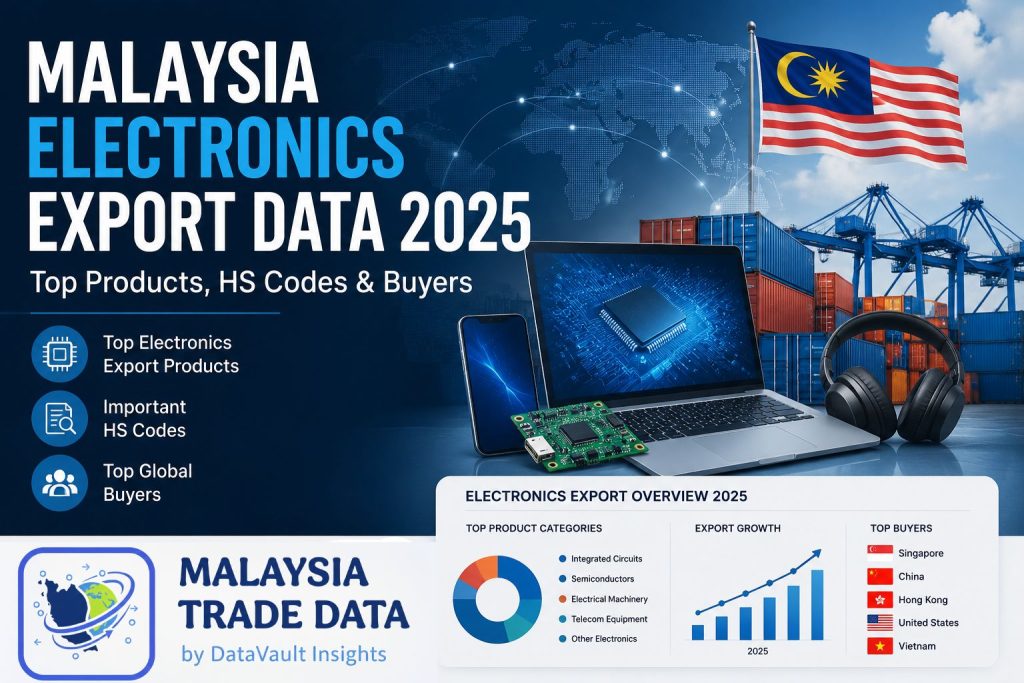
Introduction Malaysia has firmly established itself as one of Southeast Asia’s most powerful electronics exporters. In 2025, malaysia electronics export data reveals that the country exported over $151.57 billion worth of electrical machinery and electronics—making it the single largest export category by far. For businesses looking to source electronics from Malaysia, find verified buyers, track competitor shipments, or enter new markets, accessing verified malaysia electronics export data is no longer optional—it is a strategic necessity. In this guide, we break down Malaysia’s top electronics export products, key HS codes, leading buyer countries, and how to access real-time malaysia export data for your business. Why Malaysia is a Global Electronics Powerhouse Malaysia’s electronics industry accounts for nearly 40% of total exports—driven by decades of investment from global technology giants including Intel, Seagate, Western Digital, Motorola Solutions, and Samsung. The country’s key electronics manufacturing hubs include the following: This strong manufacturing base, combined with skilled labor and excellent port infrastructure, makes malaysia electronics export data one of the most sought-after trade intelligence datasets globally. Malaysia Electronics Export Data 2025 — Top Products by HS Code Based on our verified malaysia export data, here are the top electronics export categories in 2025: 1. Semiconductors & Integrated Circuits — HS Code 8542 Export Value: $68.4 Billion Semiconductors are Malaysia’s single largest electronics export. Malaysia is the world’s 7th largest semiconductor exporter, with major players including Intel Malaysia, Infineon Technologies, and Texas Instruments operating large-scale facilities in Penang. Key buyers: USA, China, Singapore, Germany, South Korea 2. Electronic Components & Parts — HS Code 8473 / 8522 Export Value: $18.2 Billion Computer components, hard disk drive parts, and electronic sub-assemblies form a major portion of malaysia electronics export data. Western Digital and Seagate’s Malaysian operations contribute significantly to this category. Key buyers: USA, China, Thailand, Philippines 3. Telecom Equipment — HS Code 8517 Export Value: $14.8 Billion Mobile phones, base stations, routers, and telecom equipment. Malaysia exports significantly to ASEAN neighbors and the Middle East. Key buyers: Singapore, Indonesia, UAE, Saudi Arabia 4. Electrical Machinery & Transformers — HS Code 8504 Export Value: $12.3 Billion Power transformers, inductors, and electrical conversion equipment. Strong demand from industrial buyers in Europe and North America. Key buyers: USA, Germany, Netherlands, Australia 5. Printed Circuit Boards (PCBs) — HS Code 8534 Export Value: $8.6 Billion Malaysia is a leading PCB manufacturer for the global electronics supply chain. PCBs are exported to electronics assembly hubs across Asia. Key buyers: China, Vietnam, Thailand, Japan 6. Optical & Electronic Instruments — HS Code 9001 / 9013 Export Value: $6.2 Billion Optical fibers, lenses, and precision instruments for medical and industrial applications. Key buyers: USA, Germany, Japan, South Korea Malaysia Electronics Export Data — Top Buyer Countries 2025 According to our malaysia electronics export data, the top destination countries for Malaysian electronics in 2025 are: Rank Country Export Value Key Products 1 United States $54.58B Semiconductors, HDD parts, PCBs 2 Singapore $28.4B Electronics components, telecom 3 China $22.1B Semiconductors, PCBs, components 4 Japan $12.6B Electronic instruments, components 5 South Korea $8.9B Semiconductors, display components 6 Germany $7.2B Electrical machinery, instruments 7 Netherlands $6.8B Electronics, semiconductors 8 Thailand $5.9B Electronic components, PCBs 9 Vietnam $5.4B Electronics parts, telecom 10 Australia $4.8B Telecom equipment, instruments The United States remains by far the largest buyer of Malaysian electronics — particularly semiconductors and hard disk drive components manufactured by US multinationals operating in Malaysia. How to Use Malaysia Electronics Export Data for Business Businesses across multiple industries use malaysia electronics export data to gain strategic advantages: For Importers & Buyers For Exporters & Manufacturers For Market Researchers & Analysts For Logistics & Trade Companies Key HS Codes for Malaysia Electronics Export Data When searching Malaysia electronics export data, these are the most important HS codes to filter by: HS Code Product Category 2025 Export Value 8542 Semiconductors & ICs $68.4B 8473 Computer parts & accessories $18.2B 8517 Telecom equipment $14.8B 8504 Electrical transformers $12.3B 8534 Printed circuit boards $8.6B 8471 Computers & laptops $7.1B 8544 Electric conductors & cables $6.8B 9013 Optical instruments $6.2B 8536 Electrical switches & relays $4.9B 8532 Capacitors $3.8B How to Access Verified Malaysia Electronics Export Data Getting accurate, real-time malaysia electronics export data requires a trusted trade data provider. Here is what to look for: 1. Shipment-level records—Not just statistics but actual buyer and exporter names, shipment dates, quantities, and values. 2. HS code filtering — Ability to filter by specific product codes to get targeted results. 3. Regular updates — Monthly or more frequent data updates to ensure you have current market intelligence. 4. Multiple countries — Coverage beyond just Malaysia to include buyer country data for complete supply chain intelligence. 5. Downloadable formats—Excel, CSV, or API access for easy integration into your analysis workflow. At Malaysia Trade Data, we provide verified malaysia electronics export data with: Malaysia Electronics Export Trends 2023–2025 Our Malaysian export data shows strong growth in electronics exports over the past three years: Year Electronics Export Value YoY Growth 2023 $119.18B — 2024 $121.40B +1.9% 2025 $151.57B +24.9% The remarkable 24.9% growth in 2025 reflects the global semiconductor demand surge, driven by AI hardware requirements, data center expansion, and electric vehicle electronics demand from Europe and North America. Frequently Asked Questions Q: What is Malaysia’s top electronics export product? A: Semiconductors and integrated circuits (HS 8542) with $68.4 billion in exports in 2025. Q: Which country buys the most Malaysian electronics? A: The United States is the largest buyer with $54.58 billion in electronics imports from Malaysia in 2025. Q: How do I find verified Malaysian electronics exporters? A: Use our malaysia electronics export data platform at malaysiatradedata.com to search by HS code and get verified exporter names, addresses, and shipment records. Q: Is Malaysia electronics export data available for free? A: A free sample is available at malaysiatradedata.com. Full access requires a subscription plan. Conclusion Malaysia’s electronics export sector continues to grow at an impressive pace, making Malaysia electronics export data one of the most