


Malaysia–Singapore Trade: Top Imported Products in 2026
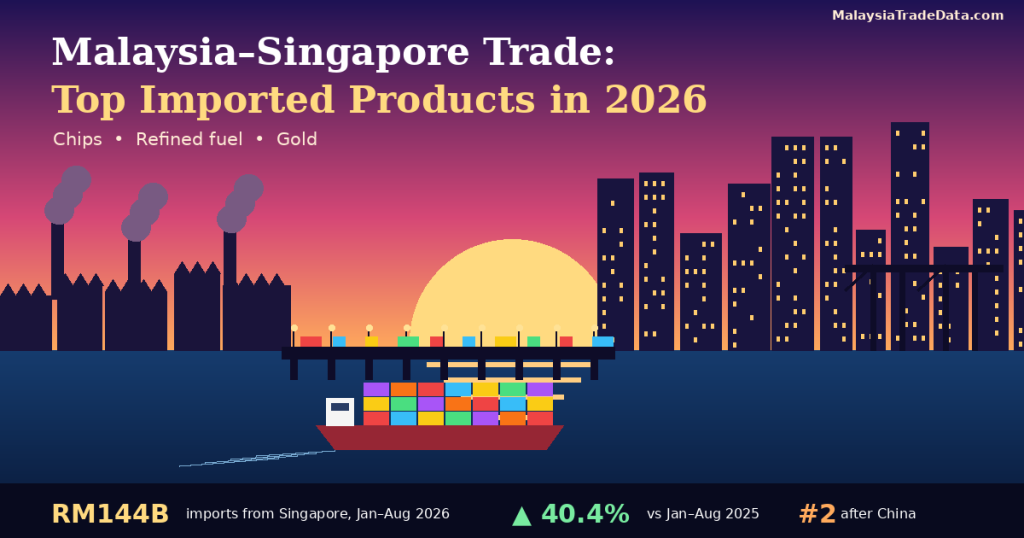
Malaysia–Singapore Trade: Top Imported Products in 2026 | Chips, Refined Fuel and the 2026 Import Surge 🇲🇾🇸🇬 Malaysia’s Imports from Singapore Jumped 40.4% in Jan–Aug 2026 — Chips, Refined Fuel and Gold Lead the Basket Malaysia–Singapore Trade: Top Imported Products in 2026 | Chips, Refined Fuel and the 2026 Import Surge Published: October 19, 2026 | By MalaysiaTradeData Research Team | 11 min read Home › Blog › Malaysia–Singapore Trade: Top Imported Products in 2026 Singapore is Malaysia’s second-largest source of imports, and the flow is accelerating. Between January and August 2026, Malaysia imported RM144.4 billion of goods from Singapore, up 40.4% from the same period of 2025, according to Malaysia’s national statistics agency (DOSM). Three product groups — integrated circuits, refined petroleum, and gold — make up more than half of the basket. This guide breaks down what Malaysia buys from Singapore, how the 2026 surge compares with other suppliers, and why the bilateral surplus is narrowing. Malaysia–Singapore Trade Overview: A Gateway, Not Just a Supplier Singapore plays two roles for Malaysia at once. It is a producer of high-value goods such as memory chips and refined fuel, and it is a regional hub through which many products are shipped, stored, and traded. As a result, “imports from Singapore” often reflect where goods were last processed or shipped from, not only where they were first made. That is worth keeping in mind when reading any origin statistic. The relationship runs both ways. Singapore is also Malaysia’s second-largest export destination, taking RM195.0 billion in January–August 2026, or 14.4% of all exports, behind only the United States. Malaysia therefore runs a surplus with Singapore, but, as shown below, imports have been growing faster than exports. 🇲🇾🇸🇬 Malaysia–Singapore Trade — Key Statistics Metric Value Detail Imports from Singapore (2025) ≈ US$35.65 Billion UN COMTRADE; other databases show US$32.6–35.7 billion Imports from Singapore (Jan–Aug 2026) RM144.36 Billion ▲ 40.4% vs RM102.84 billion; 12.5% of total imports Imports from Singapore (Aug 2026) RM18.98 Billion ▲ 59.1% year-on-year Exports to Singapore (Jan–Aug 2026) RM195.03 Billion ▲ 18.9%; 14.4% of exports Approximate Surplus (Jan–Aug 2026) RM50.7 Billion Down from about RM61.2 billion a year earlier Singapore’s Share of ASEAN Imports (Aug 2026) 51.5% Largest ASEAN source by far Source: MalaysiaTradeData.com Research, compiled from DOSM External Trade Statistics (August 2026), UN COMTRADE, and TradeInt analysis What Malaysia Imports from Singapore Three codes dominate. Integrated circuits (HS 8542) make up about 26.5% of imports from Singapore, refined petroleum (HS 2710) about 23.8%, and gold (HS 7108) about 3.6%. Together that is roughly 54% of the total; the remaining 46% is spread across hundreds of other lines. HS Code Product Share of Imports from Singapore (2025) 8542 Electronic integrated circuits 26.5% (≈ US$9.45 billion) 2710 Refined petroleum oils 23.8% (≈ US$8.5 billion, derived from share) 7108 Gold, non-monetary 3.6% (≈ US$1.3 billion, derived from share) — All other products 46.1% 1. Integrated Circuits and Electronics Electrical and electronic goods totalled about US$13.55 billion in 2025, led by integrated circuits at US$9.45 billion. Beyond chips, the next-largest lines were electrical switching and protection apparatus (about US$550 million), line telephony equipment (US$414 million), storage media such as solid-state devices (US$392 million), printed circuits (US$222 million), transformers (US$206 million), and electric motors (US$170 million). TradeInt’s records list a Singapore-based unit of a major memory-chip maker among the top suppliers, which fits the pattern of Singapore wafer and memory production feeding Malaysian packaging and test plants. For the Malaysian side of this chain, see our electronics import guide for HS 8542. 2. Refined Petroleum Singapore is one of Asia’s main refining and fuel-trading hubs, which explains why refined petroleum is its second-largest export to Malaysia. OEC figures put the 2024 value at about US$8.9 billion. Prices matter here: across all suppliers, Malaysia’s refined petroleum imports in August 2026 rose 24.9% in value even though volumes fell 10.5%, because average unit values jumped 39.4%. In other words, part of the fuel bill reflects price, not quantity. Our crude petroleum import guide covers the upstream side. 3. Gold Gold is a smaller line but a consistent one. OEC data show about US$1.59 billion in 2024, and our gold import analysis explains the wider bullion trade. Because gold values move with prices, this line can swing even when physical volumes are steady. 📖 Also Read: Malaysia–Taiwan Trade: Top Imported Products in 2026 Malaysia–US Trade: Top Imported Products in 2026 Malaysia–China Trade: Top Imported Products in 2026 The 2026 Surge: How Singapore Compares with Other Suppliers Malaysia’s imports have exploded in 2026. Total imports reached RM1,157.6 billion in January–August, up 22.4%, and electrical and electronic imports rose 40.3% to RM506.5 billion. In August alone, E&E imports jumped 89.3% to RM81.2 billion, while imports of parts and accessories for capital goods roughly doubled (+101.6%), a pattern consistent with the AI and data center hardware build-out we analysed in our AI server and GPU import guide. Within that surge, Singapore grew faster than the overall average. Its share of Malaysia’s imports rose from about 10.9% to 12.5%. Only South Korea (+60.8%) and, narrowly, China (+41.2%) grew faster or similarly among the top five origins, while imports from the United States fell 11.4%. Origin Jan–Aug 2025 Jan–Aug 2026 Change China RM218.3 Billion RM308.1 Billion ▲ 41.2% Singapore RM102.8 Billion RM144.4 Billion ▲ 40.4% Taiwan RM98.4 Billion RM118.4 Billion ▲ 20.3% United States RM95.7 Billion RM84.8 Billion ▼ 11.4% South Korea RM41.7 Billion RM67.0 Billion ▲ 60.8% Monthly rankings can shift. In August 2026, Taiwan (RM21.6 billion) edged ahead of Singapore (RM19.0 billion), though Singapore remains second over the full January–August period. For the other big suppliers, see our Taiwan and US import guides. The Two-Way Balance: A Narrowing Surplus Malaysia exported RM195.0 billion to Singapore in January–August 2026, up 18.9%, led by electrical and electronic products, machinery, and petroleum products. Because imports from Singapore grew more than twice as fast (+40.4%), the bilateral surplus narrowed from roughly RM61.2 billion to about RM50.7 billion. These figures mix export values recorded
Malaysia–Taiwan Trade: Top Imported Products in 2026
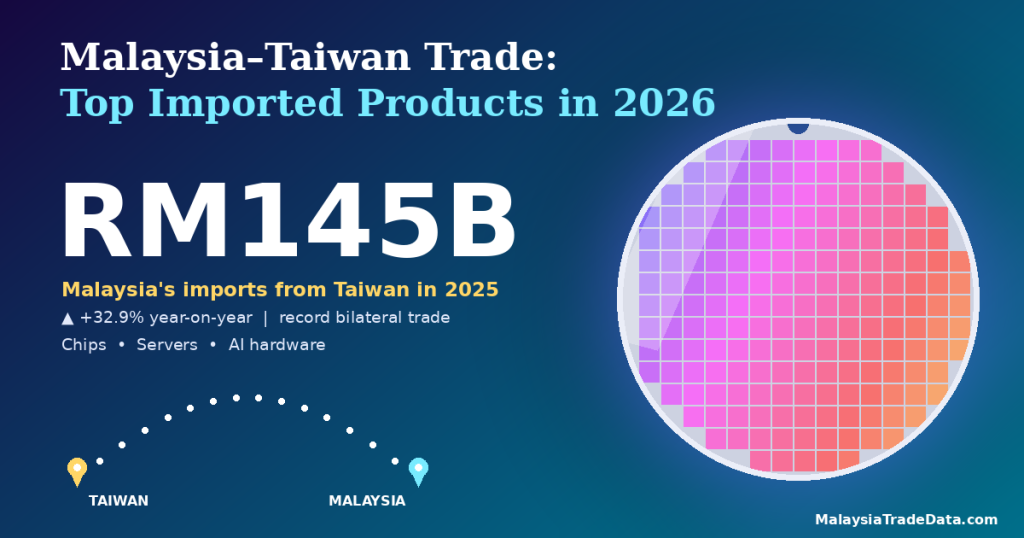
Malaysia–Taiwan Trade: Top Imported Products in 2026 | Chips, Servers and the AI Supply Chain 🇲🇾🇹🇼 Malaysia’s Imports from Taiwan Hit a Record RM145 Billion in 2025 (+32.9%) — Chips and Servers Lead Malaysia–Taiwan Trade: Top Imported Products in 2026 | Chips, Servers and the AI Supply Chain Published: October 17, 2026 | By MalaysiaTradeData Research Team | 11 min read Home › Blog › Malaysia–Taiwan Trade: Top Imported Products in 2026 Malaysia imported RM145.07 billion of goods from Taiwan in 2025, up 32.9% and a new record, according to Malaysia’s trade ministry. Taiwan is now Malaysia’s third-largest import source after China and Singapore, and more than 80% of what Malaysia buys from it comes down to just three product codes: integrated circuits, computers, and computer parts. This guide breaks down what Malaysia imports from Taiwan, why the flow is growing so fast, and what early 2026 data suggests. Malaysia–Taiwan Trade Overview: A Record Year, and a Deficit Trade between the two economies reached RM233.02 billion in 2025, growing 32.3% and accounting for 7.6% of Malaysia’s total trade. Exports to Taiwan also hit a record, rising 31.2% to RM87.95 billion on strong shipments of electrical and electronic products, optical and scientific equipment, and machinery. However, imports grew even faster, so Malaysia ran a bilateral deficit of roughly RM57 billion with Taiwan. This is the opposite of Malaysia’s position with the United States, where it runs a large surplus, as covered in our Malaysia–US imports guide. The reason is structural. Taiwan supplies the upstream, high-value inputs — wafers, chips, and server hardware — while Malaysia handles much of the assembly, packaging, and testing further down the chain. 🇲🇾🇹🇼 Malaysia–Taiwan Trade — Key Statistics (2025) Metric Value Detail Total Bilateral Trade RM233.02 Billion ▲ 32.3% — record, 7.6% of Malaysia’s trade Malaysia’s Imports from Taiwan RM145.07 Billion ▲ 32.9% — roughly US$34 billion Malaysia’s Exports to Taiwan RM87.95 Billion ▲ 31.2% — record high Approximate Bilateral Deficit RM57 Billion Imports minus exports Taiwan’s Rank as Import Source #3 After China and Singapore Top Import Code (HS 8542) ~56.5% Integrated circuits, share of imports from Taiwan Source: MalaysiaTradeData.com Research, compiled from Malaysia’s Ministry of Investment, Trade and Industry (MITI) 2025 trade performance report and TradeInt analysis What Malaysia Imports from Taiwan: Three Codes Dominate Product concentration is extreme. Integrated circuits under HS 8542 account for about 56.5% of Malaysia’s imports from Taiwan, computers and servers under HS 8471 add roughly 15.2%, and computer parts under HS 8473 contribute about 10.2%. Together, these three codes make up around 81.9% of the total. Everything else, from machinery to chemicals, shares the remaining 18.1%. HS Code Product Share of Imports from Taiwan 8542 Electronic integrated circuits 56.5% 8471 Computers and data-processing machines (incl. servers) 15.2% 8473 Parts and accessories for computers 10.2% — All other products 18.1% Why Chips Flow Both Ways It may look odd that Malaysia both imports and exports large volumes of chips. In practice, the two flows are different stages of the same supply chain. Wafers and advanced chips arrive from Taiwan, Malaysian facilities in Penang, Selangor, and Johor then package and test them, and finished or semi-finished products flow back out. That is why Malaysia’s exports to Taiwan also set a record in 2025. For the equipment side of this process, see our semiconductor equipment import guide. Taiwan in Malaysia’s Electronics Imports: The Fastest-Growing Source Electrical and electronic goods are Malaysia’s single largest import category, at MYR 469 billion in 2025. Within that, Taiwan supplied about MYR 92.6 billion — close to one-fifth — making it Malaysia’s second-largest source after China. More importantly, Taiwan was the fastest-growing origin, adding roughly MYR 25 billion compared with 2024, ahead of China (+MYR 18.5 billion) and South Korea (+MYR 14.7 billion). Origin E&E Imports (2025) China MYR 121 Billion Taiwan MYR 92.6 Billion Singapore MYR 58 Billion United States MYR 44.3 Billion South Korea MYR 33.1 Billion For the China side of this picture, see our Malaysia–China imports guide. The AI Hardware Connection A growing share of the Taiwan flow is tied to artificial intelligence. Taiwan’s computing-system exports to Malaysia jumped 366% year-on-year in March 2025, and Malaysia’s GPU imports reached $6.45 billion in the first four months of that year, as we detailed in our AI server and GPU import analysis. Taiwanese server makers are also directly involved in Malaysian projects — Wiwynn is a partner in a large AI data center complex in Johor. As a result, HS 8471 and 8473 now carry far more weight in this relationship than they did a few years ago. 📖 Also Read: Malaysia Electronics Import Data 2026 – HS Code 8542 Guide Malaysia Printed Circuit Board Import Data – HS Code 8534 Malaysia Import Data – Complete Trade Intelligence Momentum Check: 2025 Surge vs Early 2026 The growth rate has not been steady. Imports from Taiwan were up 40.3% in the first five months of 2025, finished the full year up 32.9%, and then fell 13.6% in January 2026, even as exports to Taiwan hit another record. Period Imports from Taiwan Change vs Prior Year Jan–May 2025 RM60.47 Billion ▲ 40.3% Full Year 2025 RM145.07 Billion ▲ 32.9% January 2026 RM12.89 Billion ▼ 13.6% One month is a noisy signal, especially because AI hardware shipments tend to arrive in large lumps rather than steadily. Even so, one H1 2026 analysis reports that Malaysia’s imports of memory and logic chips (HS 854232) reached $19.49 billion, up 240% year-on-year, with Taiwan among the fastest-growing sources — a reminder that the longer-term direction remains upward. A Note on Data Sources Figures for Malaysia’s imports from Taiwan differ between sources. Malaysia’s trade ministry reports RM145.07 billion for 2025 (about US$34 billion), while commercial databases show US$31.0 billion to US$33.9 billion, depending on valuation method and classification. We use the official ringgit figure as the anchor, and treat HS-level shares as approximate. 🇲🇾🇹🇼 Get Verified Malaysia–Taiwan Trade Data Access shipment-level Malaysia import data from Taiwan with HS codes, buyer
Malaysia–China Trade 2026: Top Imported Products & Data
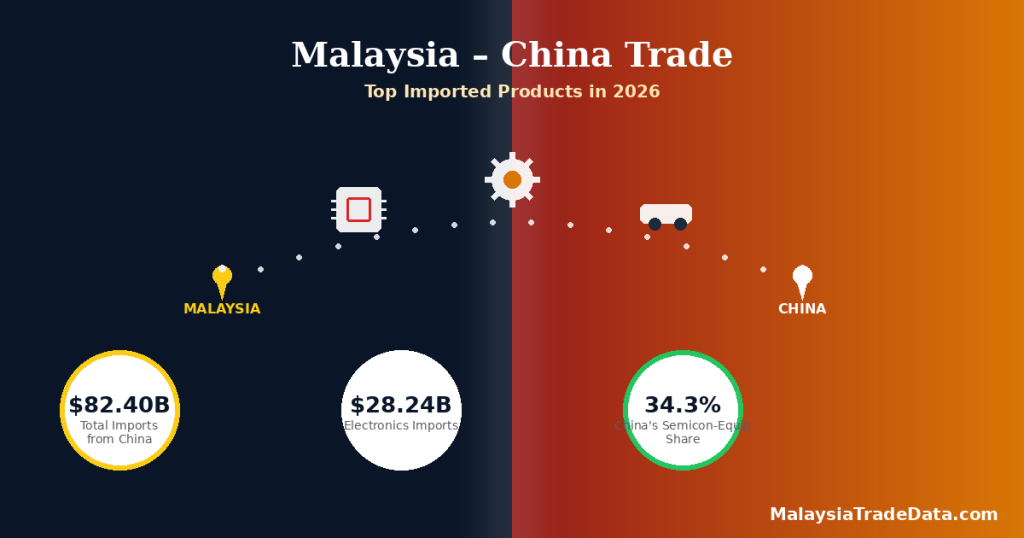
Malaysia China Trade: Top Imported Products 2026 🇨🇳 China Supplied $82.4 Billion in Goods to Malaysia in 2025 — Electronics Alone Accounted for $28.24 Billion Malaysia–China Trade: Top Imported Products in 2026 | Electronics, Machinery & Trade Insights Published: September 19, 2026 | By MalaysiaTradeData Research Team | 12 min read Home › Blog › Malaysia–China Trade: Top Imported Products in 2026 This Malaysia China trade guide breaks down exactly what Malaysia imports from China in 2026. China remains Malaysia’s single largest source of imports by a wide margin, supplying $82.40 billion in goods in 2025 — roughly a quarter of everything Malaysia buys from the world. Electronics alone accounted for over a third of that figure, and we cover which categories are growing fastest. Malaysia China Trade Relationship Overview China has held the position of Malaysia’s top import source for well over a decade, and Malaysia China trade has only deepened over time. According to UN Comtrade data, Malaysia imported $82.40 billion worth of goods from China in 2025, representing roughly 24-25% of Malaysia’s total import value — a concentration far higher than any other single trading partner. Singapore, the second-largest source, supplies less than half that amount. For related country-level data, see our Malaysia Import Data hub. This concentration reflects Malaysia’s deep integration into China-centred electronics and machinery supply chains — a defining feature of Malaysia China trade today. As Malaysia’s own semiconductor and manufacturing base has expanded (see our AI Server & GPU Import Data report), so too has its reliance on Chinese components, machinery, and intermediate goods to feed that growth. 🇨🇳 Malaysia–China Trade — Key Statistics Metric Value Detail Total Malaysia Imports from China (2025) $82.40 Billion ~24-25% of Malaysia’s total imports Electrical & Electronic Equipment $28.24 Billion Largest single import category Machinery, Nuclear Reactors, Boilers $18.21 Billion 2nd largest category Vehicles (Other Than Railway) $3.59 Billion 3rd largest category China’s Share of Malaysia Semicon-Equipment Imports 34.3% Jan–Apr 2026, up from 22.8% in 2025 Malaysia’s Share of China’s Steel Imports into ASEAN Top 6 46%+ of Malaysia’s metal imports from China (May 2025) Source: MalaysiaTradeData.com Research, compiled from UN Comtrade and industry trade reporting Malaysia China Trade: Full Product Breakdown Electronics dominate Malaysia China trade, but the product mix extends well beyond chips and circuit boards. The chart below shows the six largest product categories Malaysia imports from China. Rank Product Category Import Value (2025) 1 Electrical & Electronic Equipment $28.24 Billion 2 Machinery, Nuclear Reactors, Boilers $18.21 Billion 3 Vehicles (Non-Railway) $3.59 Billion 4 Plastics $2.73 Billion 5 Mineral Fuels, Oils $2.32 Billion 6 Iron and Steel $2.28 Billion 7 Articles of Iron or Steel $2.28 Billion 8 Furniture, Lighting, Prefab Buildings $1.58 Billion 9 Optical, Technical, Medical Apparatus $1.54 Billion 10 Organic Chemicals $1.52 Billion 1. Electronics: Chips, Circuits, and Telecom Equipment Within the $28.24 billion electronics category, integrated circuits and microassemblies form the single largest line item, alongside electrical apparatus for line telephony, printed circuits, and transformers. Notably, Malaysia both imports heavily from and exports heavily to China in electronics — Malaysia exported $44.08 billion in electrical and electronic equipment to China in 2025, meaning the two countries are deeply enmeshed in shared supply chains rather than simply running a one-directional trade relationship. 2. Machinery: The Second Pillar Machinery, nuclear reactors, and boilers made up $18.21 billion of imports in 2025 — the second-largest category after electronics. This includes industrial machinery and, increasingly, semiconductor manufacturing equipment, where China’s role has been expanding rapidly. 3. Steel: A Politically Sensitive Category Iron and steel, plus articles of iron and steel, together totalled $4.56 billion in 2025. This category draws particular scrutiny because of pricing: Chinese hot-rolled coil and other flat steel products are typically priced $10 to $115 per metric tonne lower than competing suppliers from India or Turkey, a gap driven by China’s scaled-up production capacity. As of May 2025, more than 46% of Malaysia’s metal imports originated from China, making Malaysia one of the top six importers of Chinese steel in the region — a dynamic that has already prompted Malaysia to impose anti-dumping duties on certain Chinese steel products. 📖 Also Read: Malaysia Steel & Iron Export Data – HS Code 7208 | US Section 232 Impact Malaysia AI Server & GPU Import Data – HS Code 8471 & 8542 Malaysia Importer List – Top Companies & Source Countries The Fastest-Growing Import Category: Semiconductor Equipment While electronics and machinery already dominate by dollar value, one narrower category is growing at a remarkable pace: semiconductor device manufacturing machines. China’s share of this specific import category has climbed sharply over the past year, from 22.8% of Malaysia’s total semiconductor equipment imports in 2025 to 34.3% in the four months to April 2026. Total imports of semiconductor device manufacturing machines into Malaysia reached $608.7 million in 2025 alone, with China, Japan, and the United States as the three largest suppliers. The average import price for this equipment also rose, from $382,500 per tonne in 2024 to $435,760 per tonne in 2025 — consistent with the broader global surge in demand for advanced chipmaking equipment tied to AI infrastructure buildouts, a trend we’ve covered in detail in our piece on Malaysia’s AI server and GPU imports. 🇨🇳 Get Verified Malaysia–China Trade Data Access shipment-level Malaysia import data from China with buyer details, supplier names, and verified HS code-level trade records. Perfect for market research, competitor analysis & B2B lead generation. Explore Malaysia Trade Data → Why Malaysia’s Import Dependence on China Keeps Growing Several forces are reinforcing this concentration rather than diversifying it. First, Malaysia’s own semiconductor manufacturing expansion — driven by new investment from Intel, Micron, and others — requires a steady, scaled supply of components and equipment, and China has become an increasingly competitive supplier of both. Second, China’s steel and industrial goods carry a structural price advantage that is difficult for competing suppliers to match. Third, Malaysia’s own exports to China (particularly electronics, at $44.08 billion in 2025) mean the trade
Malaysia Trade Data: Complete Guide for Business Growth and Market Analysis

Introduction In the current globalized business environment, companies require accurate and reliable information in order to achieve success. A single of the most effective tools to trade internationally includes Malaysia trading data. It gives detailed insight into the export and import processes that help companies comprehend the market’s trends, find opportunities, and take better business decision-making. Malaysia is a significant trading center within Southeast Asia, with strong connections to international markets like China and China, the United States, India, and Europe. Companies that make use of Malaysia trade data could benefit from competitive advantages and expand their business internationally. What is it? Malaysia Trade Data? Malaysia trade data is complete records of the goods that are exported and imported. This information includes crucial details such as product descriptions shipping values, HS codes quantity, countries involved, and even company information. Through analyzing these data, companies can see the products that are most popular and what markets are growing. Key Components of Trade Data Trade data is one of the most essential elements that allow businesses to make educated decisions: These tools allow businesses to conduct thorough market research and find profitable opportunities. Top Benefits of Malaysia Trade Data 1. Market Research and Trend Analysis Malaysia trade data can help companies determine which items are in demand on the market. Companies can examine the volume of export and import to determine patterns of demand. 2. Finding Buyers and Suppliers Companies can utilize trade data to determine reliable suppliers and buyers. This can help in establishing strong relationships with suppliers and improving their the efficiency of supply chains. 3. Competitor Analysis Companies can keep track of competitors’ activities by studying the types of products they import or exporting. This can help businesses refine their strategies to stay in the game. 4. Risk Reduction By using accurate data, you can minimize the possibility of entering into an unsuitable market, or investing into a low-demand products. 5. Business Expansion Trade data helps companies discover potential markets, and to expand internationally without a doubt. Malaysia Trade Data Overview (Example Table) Product Category Valuation of Imports (USD) Export Value (USD) Top Partner Country Electronics 120 Billion 150 Billion China Machinery 80 Billion 60 Billion Japan Chemicals 45 Billion 50 Billion Singapore Palm Oil 10 Billion 70 Billion India Textiles 15 Billion 20 Billion USA Note This data is intended for illustration only. How Businesses Use Malaysia Trade Data Different industries use trade data in different ways: For instance an electronics manufacturer can analyse import data to determine products that are in high demand and then launch their products with confidence. Real-World Example Imagine a company wishing trade palm oils. After analysing Malaysia export statistics it can pinpoint the top countries that import, such as India as well as China. This helps the company find the right market and boost sales. Similar to import data, import data helps businesses find suppliers that have the same shipment records, assuring security. The importance of HS Codes for Trade Data HS codes play an essential function in the analysis of trade data. They categorize products into categories, which makes it easier to study trade patterns. Businesses can utilize codes from HS to: Future of Trade Data in Malaysia Technology advancements mean that the data on trade is now more easily accessible and precise. Businesses are now able to use real-time data analytics in order to make better and faster choices. Malaysia’s robust trade infrastructure and the growth of digital technology will continue to increase the importance for trade information in the coming years. Conclusion Malaysia Trade data are a crucial instrument for companies looking to expand into international markets. It assists in market research and the identification of suppliers competitive analysis, supplier identification, as well as strategic plan. Companies that use trade data effectively will reduce risks, enhance decision-making and ensure long-term success in international trade. Learn more: https://malaysiatradedata.com
Why Import Data is Important for Businesses in Malaysia

In the modern digital world businesses depend heavily on precise and structured information to make the right decisions. In Malaysia where sectors like logistics, e-commerce and international trade are growing rapidly, import data has become an important source for businesses seeking for ways to grow their business and gain insight into the market’s trends. Import data gives specific information on the products that enter the country, including shipping details, information about suppliers as well as product categories and trade quantities. Companies use this data to assess market demand as well as to analyze competition and devise better sourcing strategies. Understanding Import Data Import data refers to data of the goods that enter the country from markets outside of international trade. In Malaysia this information includes details such as: Businesses analyze this data to find out which items are most sought-after and from where they’re coming from. the Malaysian Growing Import Market Malaysia is among the most active trading countries. The country imports a diverse variety of goods, including electronics machinery as well as chemicals and consumer products. Companies who study Malaysia import statistics will gain valuable information regarding market demand as well as emerging industries. Product Category The Import Value (Approx) Major Source Countries Electronics $45 Billion China, Singapore, Japan Machinery $32 Billion China, Germany, USA Chemicals $18 Billion Japan, South Korea Consumer Goods $12 Billion China, Thailand These numbers demonstrate that international trade is a key factor within Malaysia’s economy. The benefits of import data for Business 1. Market Research Import data can help companies determine which items are in high demand in Malaysia. Businesses can look at trends and introduce products that are already in demand on the market. 2. Analysis of Competitors By studying the records of their shipment companies can discover which competitors they are competing against and from where they source their goods. 3. Supplier Identification Import data make it easier to locate reliable manufacturers and suppliers in the international market. 4. Strategic Business Planning Businesses can better plan their prices, inventory and marketing strategies through looking at import patterns. Import Data’s Role Import Data’s Role E-Commerce Growth E-commerce companies operating in Malaysia typically depend on import statistics to determine the most popular products. Many online sellers look at international trade data to determine which products to offer on marketplaces like Lazada and Shopee. With accurate information the sellers can lower risks and increase the likelihood of successful business. Future of Import Data in Malaysia With the growth of AI-based digital analytics and platform for trade intelligence, data on imports becomes more efficient. Companies are employing automated tools to analyse trade data and identify new opportunities more quickly than before. Malaysia’s strategic position and its strong trade relationships will continue to drive up the demand for data on imports in the years ahead. Conclusion Import data plays a vital role in helping businesses to understand the trends in global trade and market patterns. In Malaysia the country where trade is a major component in the economic system, firms who utilize Malaysia data import analysis will gain an benefit and be able to make more informed business choices.
Top Benefits of Malaysia Import Data for Business Growth in 2026

Introduction In today’s globalized market data plays a vital aspect in the business’s success. The most important kinds of data that companies use with international commerce are export data. In Malaysia where trade and commerce are expanding, companies are utilizing import data to gain an edge in the market. Knowing Malaysia import information can assist companies in identifying market trends, study competitors, and identify lucrative opportunities. What exactly is import Data? Import data is the detailed documents of the goods that enter the country. In Malaysia this information includes information like product type size, quantity, value of shipment information about the supplier, as well as the country of the country of. Businesses rely on this data to determine what products are in high demand and how market trends are developing. The reason Malaysia is important for Global Trade Malaysia is among the most important trading hubs in Southeast Asia. The strategic location, the strong infrastructure along with trade and investment agreements, make it a key centre for exports and imports. Industries like machinery, electronics, as well as consumable goods are the mainstays of Malaysia’s export market. This means that Malaysia import information extremely important for companies seeking to expand into Asia. The main benefits for Malaysia Import Data 1. Better Market Research Import data can help businesses determine which products are popular in Malaysia. Businesses can determine which products are most imported and determine the most popular products. 2. Analyzing Competitors By studying records of shipping companies can determine their rivals and gain insight into their methods of sourcing. 3. Finding Reliable Suppliers Import data provide information on suppliers and exporters. This helps companies establish relationships with reliable manufacturers from various nations. 4. Opportunities to Expand Business Companies who are looking to join the Malaysian market can benefit from import data to limit the risk and make educated decisions. Real-World Example For instance If a company discovers that electronic devices are extensively imported into Malaysia It can then begin selling similar products, or search for superior suppliers to compete in the market. This approach based on data enhances the likelihood of success, and also reduces the risk of business. What E-commerce companies can do with Import Data Online sellers from Malaysia utilize import data to determine the most popular items before they are well-known. Platforms like online marketplaces depend heavily on data-driven insights to remain ahead of the competition. Through analyzing trends in imports sellers can choose which items to keep in stock and price them efficiently. Future of Import Data in Malaysia With the development of AI and digital tools, analysis of data imported from import is getting more sophisticated. Companies can now get live data and forecast future trends with more accuracy. The growing economy of Malaysia and its trade relations will continue to enhance the significance of data on imports in the years ahead. Conclusion Malaysia import data can be an effective tool for companies seeking to expand their business in international markets. It can help companies comprehend the demand for their products, study competitors, and locate reliable suppliers. Companies that employ data-driven strategies are more likely to be successful and remain ahead of the curve in today’s highly competitive marketplace.